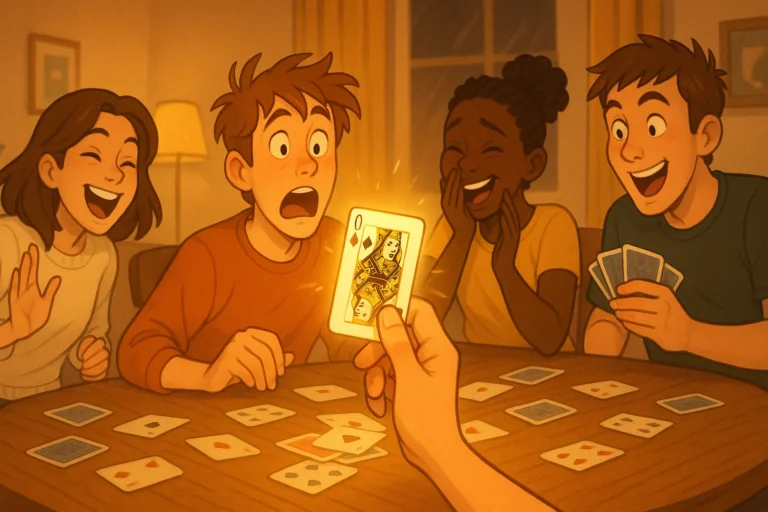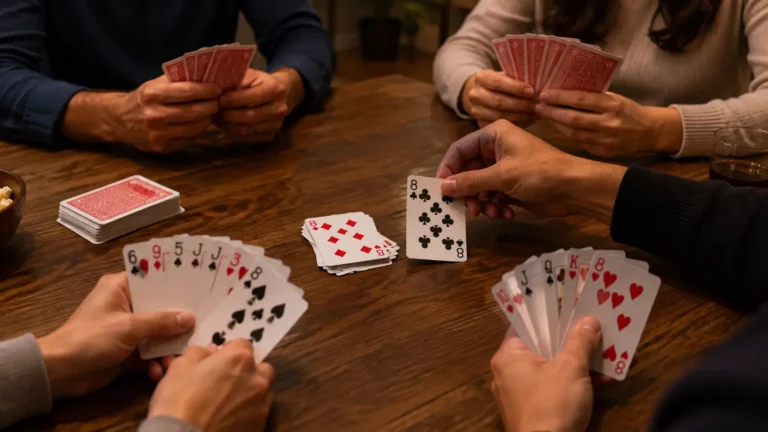

The Go F**k Yourself card game is a fast-paced shedding game played with a standard deck of cards. Your aim is to clear the cards in your hand, then your face-up cards, and finally your face-down cards before the other players.
On each turn, you normally place an equal or higher-ranked card on the discard pile, while special cards such as 2s and 10s can reset or clear play. If you cannot make a legal move, you pick up the pile, which can quickly change the course of the game.
What Is the Go F**k Yourself Card Game?

The Go F**k Yourself card game is a shedding or beating game played around a shared discard pile. Your objective is to clear every card you hold and every card arranged in front of you without becoming the last player left in the round.
The standard-deck game belongs to the same broad family as Palace, Shithead, Karma, Shed and Caboodle. These games use a layered layout and require each new play to match or beat the previous rank. A player who cannot continue normally collects the pile.
Despite its provocative name, the game involves familiar card-game skills: remembering previous plays, managing matching ranks and deciding when to use powerful cards. Luck matters most during the final face-down stage, but earlier decisions can make that stage safer.
Some groups declare the first player to clear every card the winner. Others continue until only one player remains and treat that person as the round’s loser. The second approach is common in the version covered here.
Which Version of the Go F**k Yourself Card Game Are You Playing?
The name can refer to two different games. The version explained in this guide is played with an ordinary deck and uses ascending card values, a discard pile and three layers of cards.
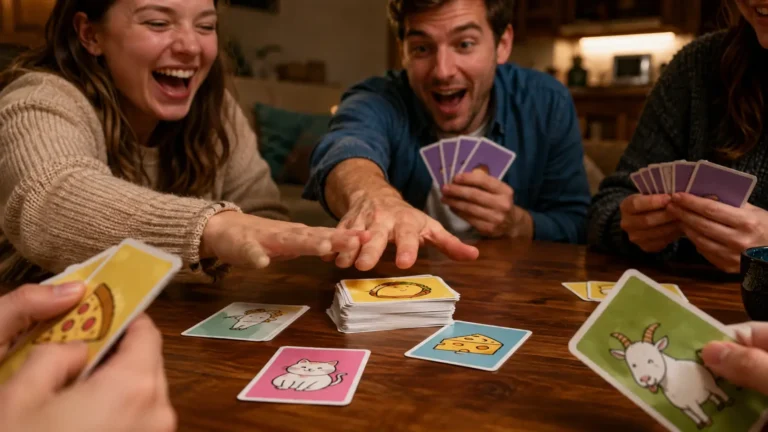
A separate commercial party game uses specially printed cards and Go Fish-style matching. Its first-party description calls it “The Adult Version of Go Fish You Always Wanted”, confirming that it is not the same shedding game.
Version Comparison
| Feature | Standard-Deck Version | Commercial Party Version |
| Cards | Standard 52-card deck | Special printed deck |
| Main action | Beat or match the previous rank. | Request and match cards |
| Card layout | Hand, face-up and face-down cards | Product-specific setup |
| Objective | Avoid being last with cards. | Complete the product’s matching objective |
| Rules | Often shaped by house variations | Defined by the printed product |
Check which deck you have before following any instructions, as the two versions are not interchangeable.
What Do You Need Before You Start Playing?
Cards and Playing Space
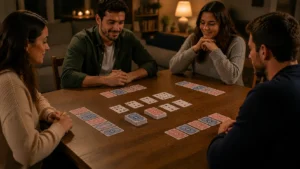
You need one standard 52-card deck and a flat surface with room for each player’s three table-card positions. You also need space in the centre for the draw pile and discard pile.
Jokers are normally removed from the basic game. If your box contains themed or prompt cards rather than ordinary playing cards, check the publisher’s official product description because you have the separate commercial version.
A recognised Palace ruleset uses the same arrangement of three hidden cards, three visible cards and three playable hand cards.
How Many People Can Play?
The standard game works with two to five players and is usually most varied with at least three. Some UK groups play with six, although they may add Jokers or another deck to maintain enough cards.
Two-player games tend to be more controlled because fewer unknown cards are circulating. Larger games are less predictable and increase the chance of a substantial discard pile developing.
Agreeing the House Rules
Before dealing, decide:
- Whether a 10 can be played on any rank.
- Whether a 7 forces the next player to go lower.
- Whether an 8 is transparent, skips or reverses play.
- Whether four consecutive matching ranks clear the pile.
- Whether Jokers are included.
- Whether players may collect the pile voluntarily.
- Whether the winner or final loser ends the round.
A brief agreement at the beginning prevents conflicting interpretations during important turns.
How Do You Set Up the Go F**k Yourself Card Game?
Shuffle the deck thoroughly and deal nine cards to every player in three layers.
First, deal three cards face down in a horizontal row in front of each person. Nobody may inspect these cards. Next, place three cards face up over the hidden cards. Finally, give each player three cards to hold.
Place the undealt cards face down in the centre as the draw pile. Leave a separate space beside it for the discard pile.
Before play begins, you may normally exchange cards between your hand and your three face-up positions. This gives you an opportunity to prepare for the later stages. High cards, matching ranks, 2s and 10s can be useful face-up choices, although keeping a balanced selection is often safer than placing three difficult cards there.
The starting player is commonly the person holding the first available 3. Some versions give priority to a face-up 3, the 3 of clubs or the lowest card held by any player. If no 3 is available, groups may move upwards through the ranks until a starter is found.
Play normally proceeds clockwise after the opening card is placed.
How Do You Play the Go F**k Yourself Card Game Step by Step?
A full round follows a clear sequence from the opening card to the final face-down play. Each stage uses the same basic rule: you must normally play an equal or higher-ranked card unless a special card changes the pile.
Step 1: Choose the Starting Player

The player holding the lowest agreed starting card begins the round. In many versions, this is a 3, with some UK groups giving priority to the 3 of clubs.
If nobody holds a 3, players move upwards through the ranks until an available starting card is found. Play then normally continues clockwise.
Step 2: Play a Legal Card or Matching Set

On your turn, place one card that is equal to or higher than the ordinary card on top of the discard pile.
You may also play several cards together when they share the same rank, such as:
- A pair
- Three of a kind
- Four of a kind
For example, you may play a 7 on a 5 or another 7. You cannot usually play a 4 on a 7 unless the 4 has a special effect under your agreed house rules.
Step 3: Apply Any Special-Card Effect

Special cards change the normal ascending sequence immediately.
A 2 usually resets the pile, allowing the next player to use any rank. A 10 normally burns or clears the discard pile, after which the same player begins a new pile.
Four consecutive cards of the same rank may also clear the pile. These cards can be played together by one player or completed across several turns, depending on the chosen rules.
Step 4: Draw Back to Three Cards

After making a legal play, draw from the central stock until you hold three cards again.
For example, if you begin your turn with three cards and play a pair, you draw two replacement cards. If only one card remains in the stock, you take that card and continue with fewer than three.
This drawing rule applies only while cards remain in the draw pile.
Step 5: Pick Up the Pile When You Cannot Play
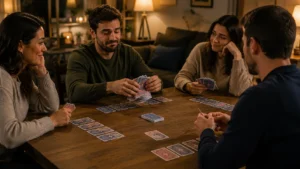
If you cannot match or beat the top card and have no usable special card, you must collect the entire discard pile.
Add every card from the pile to your hand. Your turn then ends, and the next player normally starts a fresh pile with any legal card or matching set.
You do not draw replacement cards after collecting the pile because your hand already contains more than the usual three-card minimum.
Step 6: Continue Until the Draw Pile Is Empty

Players continue taking turns, playing legal cards and drawing back to three until the central stock has been exhausted.
During this stage, your hand may not appear to shrink because every successful play is followed by replacement cards. The objective is therefore to improve the quality of your hand and prepare useful combinations for the later stages.
Once the final stock card has been drawn, every card you play permanently reduces your total.
Step 7: Clear the Remaining Cards in Your Hand

After the draw pile is empty, continue playing the cards held in your hand.
You cannot use your table cards while any hand cards remain. If you are forced to collect the discard pile, all collected cards become part of your hand and must also be cleared.
Matching ranks can be especially useful at this stage because they allow you to discard several cards during one turn.
Step 8: Move to the Face-Up Cards

When your hand is completely empty, you may begin playing the three visible cards arranged in front of you.
Choose any face-up card that can legally match or beat the current pile. You do not need to play them in the order in which they were originally dealt.
If no face-up card is legal, select one of them, place it on the discard pile and collect the entire pile into your hand. You must clear that hand before returning to your remaining table cards.
Step 9: Play the Face-Down Cards Blindly

After clearing all three face-up cards, you move to the hidden cards.
Choose one face-down card without looking at it and turn it directly onto the discard pile. If it is a legal play, it remains on the pile and the turn continues normally.
If the card is too low, collect the full discard pile together with the revealed card. You must then clear your new hand before attempting another face-down card.
Step 10: Continue Until One Player Still Has Cards

A player leaves the round after legally disposing of every hand, face-up and face-down card.
The remaining players continue until only one person still holds cards. That person normally loses the round.
For repeated games, the group may give the final player one penalty point, make that person deal the next hand or continue until someone reaches an agreed number of losses.
What Do the Special Cards Mean?
The 2 and 10 are the most widely recognised special cards, while 7s, 8s and Jokers depend more heavily on local rules.
Common Special-Card Effects
| Card or Combination | Common Effect | Important Variation |
| 2 | Resets the sequence so any rank may follow | May count as both high and low |
| 10 | Clears or burns the discard pile | Some groups restrict when it can be played |
| Four matching ranks | Clears the discard pile | May be completed over several turns |
| 7 | Requires the next play to be 7 or lower | May be an ordinary card |
| 8 | Acts as transparent, skip or reverse | The chosen effect varies |
| Joker | Reverses, resets or acts wild | Usually removed in the basic game |
A 2 can normally be placed on any card, and any rank may follow it. A 10 removes the active pile from the game, after which the same player commonly begins a new pile.
Four cards of the same rank may also clear the pile. They might be played together by one person or completed through consecutive equal-rank plays by several players. These three effects are documented in established Palace and Shithead-style rules, although details still vary.
Because optional cards can alter strategy significantly, announce every special effect before the first turn.
How Can You Improve Your Chances of Winning?
Managing Powerful Cards
Twos and tens are control cards rather than ordinary high cards. Saving one for the later stages may help you escape an ace, clear a dangerous pile or create a safer route into your face-down cards.
The official Palace playing guide also identifies 2s, 10s and four matching ranks as major pile-changing plays. Use them for a clear tactical purpose rather than simply because they are available.
When Should You Pick Up the Pile?
Voluntary collection is useful only when your house rules permit it. A small pile may provide matching ranks or prevent you from wasting a powerful card, but taking a large pile usually delays your progress.
Consider the following before collecting:
- How many cards are already in the pile.
- Whether the pile contains useful matching ranks.
- How close opponents are to finishing.
- Which control cards have already appeared.
- Whether your remaining face-up cards are easy to play.
The size and contents of the pile matter more than the embarrassment of collecting it.
Preparing for the Blind-Card Stage
Try to reach your face-down cards when the active pile is empty or showing a low rank. A blind card is more likely to succeed when many ranks remain legal.
Keep matching cards together where possible, avoid playing an ace when a lower card will work and remember which 2s and 10s have already been used. Observation cannot remove the luck of a blind play, but it can reduce avoidable risk.
Which Rule Variations and Common Mistakes Should You Know?
UK groups often adapt the game to suit their preferred pace. Variations may include a reversing Joker, transparent 8, lower-than-7 rule, timed turns or several scored rounds.
Popular Variations
- Add Jokers to accommodate a sixth player.
- Reverse the direction when a Joker appears.
- Require a card of 7 or lower after a 7.
- Treat an 8 as transparent.
- Award one penalty point to the final player.
- End a match when someone reaches three or five penalties.
- Rotate the dealer after every round.
Common beginner mistakes include using table cards while hand cards remain, forgetting to draw back to three, looking at hidden cards and wasting a 10 on an insignificant pile.
Players also misjudge the initial swap. Filling the face-up row only with high cards may look strong, but a mixture of high, matching and flexible cards can be easier to manage.
Another frequent mistake is treating one group’s variation as an official universal rule. Documented versions differ on starting cards, voluntary pickups, the powers of 7s and 8s, and whether the game ends with a winner or a final loser.
Agreeing the rules before dealing is the simplest way to keep the game competitive and fair.
Conclusion
The Go F**k Yourself card game is easy to set up but offers more strategy than its simple ascending-play rule suggests. You must manage three card layers, watch the discard pile and time special cards carefully.
Play your hand cards first, followed by the face-up cards and then the face-down cards. Use 2s to reset difficult sequences, use 10s to clear the pile and avoid collecting more cards than necessary.
Most importantly, establish the house rules before starting. Once everyone agrees on card effects, starting order and how the round ends, the game becomes a fast and adaptable choice for casual or competitive play.
Frequently Asked Questions
Can You Play Several Cards at Once?
Yes, you may normally play a pair, three of a kind or four matching cards together when that rank is legal. Mixed ranks cannot usually be combined in one turn.
Do You Draw Back to Three Every Turn?
You draw back to three only while cards remain in the central stock. Once the draw pile is empty, every successful play permanently reduces your total.
Can You Choose to Collect the Discard Pile?
Some versions allow you to collect voluntarily even when you could play. Other groups permit collection only when no legal card is available.
What Happens When a Blind Card Fails?
You collect the discard pile together with the revealed face-down card. You must clear those hand cards before attempting another hidden card.
How Long Does a Typical Round Last?
A casual round often takes approximately 10 to 25 minutes. Player count, pickups and house rules can make a round shorter or considerably longer.
Should Jokers Be Included?
Jokers are usually removed when playing the basic version with two to five people. They may be added as reversing or wild cards when everyone agrees on their effect.
Is the Game Suitable for Children or Workplaces?
The card mechanics are simple, but the common name may be inappropriate in some settings. You can use a family-friendly name such as Palace, Karma or Shed without changing the core rules.