
Players control Emma during real-time combat, using her sword, defensive actions and plant-based abilities. Successfully parrying enemy attacks generates points that can be spent on Koo’s techniques.
Opening Koo’s command menu slows time, allowing the player to choose an appropriate ability without turning the entire game into a traditional turn-based RPG. Emma’s actions and Koo’s commands are therefore designed to operate as one connected combat system.
Outside combat, players explore a changing post-apocalyptic landscape, use Emma’s vine-like hair to cross obstacles and create different builds through skill trees, equipment and Spirit Stones. Ranged, stealth-focused and aggressive combat approaches are officially supported.
Beast of Reincarnation Gameplay Summary:
| Feature | Confirmed information |
| Developer | Game Freak |
| Publisher | Fictions |
| Genre | Single-player action RPG |
| Main characters | Emma and Koo |
| Setting | Post-apocalyptic Japan in the year 4026 |
| Main combat system | Real-time sword combat combined with command-based companion techniques |
| Defensive mechanic | Parries generate points used to activate Koo’s skills |
| Exploration ability | Emma uses plant-like hair to cross terrain and attack from above |
| Build options | Skill trees, equipment and Spirit Stones |
| Supported approaches | Aggressive, ranged and stealth-focused combat |
| Platforms | PlayStation 5, Xbox Series X|S and PC |
| UK release date | 4 August 2026 on PS5 and Xbox; Steam lists 3 August 2026 |
| Multiplayer | No; it is a single-player experience |
| UK age rating | PEGI 16 for violence on Xbox |
Game Freak lists the title for PS5, Xbox Series X|S and Steam, while the UK Xbox store confirms single-player support and a PEGI 16 rating. The slight release-date difference reflects storefront timing: UK console stores list 4 August 2026, while Steam records 3 August 2026.
How to Play Beast of Reincarnation: Step-by-Step Guide
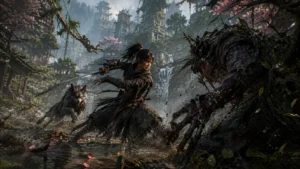
The following guide explains how the main combat, companion, progression and exploration mechanics work together.
Step 1: Understand Emma and Koo’s Different Roles
Emma is the character directly controlled by the player. She performs sword attacks, moves around the battlefield, parries incoming strikes and uses her plant-based powers for traversal and certain attacks.
Koo operates as a companion. Instead of controlling him separately, the player opens a command menu and chooses which technique he should use. This creates a partnership in which Emma handles immediate action while Koo supplies tactical support.
The important distinction is that the game is neither completely action-based nor fully turn-based. Its central feature is the movement between those two styles.
Step 2: Learn Emma’s Movement and Sword Attacks
The first priority is becoming comfortable with Emma’s real-time controls. Her sword-based combat requires players to watch enemy movements, position themselves carefully and choose the right moment to attack.
Rather than continuously pressing the attack button, players should observe how an opponent approaches, prepares a strike and recovers afterwards. Technical combat usually rewards controlled timing more than uninterrupted aggression.
A sensible early rhythm is:
- Approach the enemy carefully.
- Wait for the opponent to begin an attack.
- Defend, move or attempt a parry.
- Respond with a short sword combination.
- Move away before the enemy recovers.
Fictions describes the game as being built around demanding, technical combat, while official Xbox information highlights Emma’s fast-paced katana action.
Step 3: Practise Parrying Enemy Attacks
Parrying is one of the most important parts of Beast of Reincarnation gameplay. A successful parry, also described by the developers as a “just guard”, does more than prevent damage.
Each successful parry generates points that can be used to activate Koo’s abilities. Parrying therefore connects Emma’s defensive actions directly to the companion command system.
Players learning the timing should begin with weaker opponents and focus on one enemy at a time. It is normally easier to recognise an attack animation when Emma is not surrounded by several threats.
Practical parry tips include:
- Watch the enemy’s weapon or striking limb.
- Avoid pressing the defensive command repeatedly.
- Learn one attack pattern before trying to counter every move.
- Use short counterattacks rather than becoming overly aggressive.
- Keep enough distance to see the complete attack animation.
The exact timing will vary between enemies, so successful parrying depends on recognising individual attack patterns.
Step 4: Generate Points for Koo’s Techniques
When Emma successfully parries, points become available for Koo’s command abilities. This means defensive accuracy creates additional offensive or tactical opportunities.
The basic gameplay cycle is:
Observe → parry → generate points → command Koo → attack with Emma → reposition
Players should avoid treating the point system as something separate from sword combat. The two systems are deliberately linked: Emma creates the resource, and Koo converts it into a tactical advantage.
It may not always be best to spend the available points immediately. Saving them could provide more options when a stronger opponent enters the battle or a boss changes behaviour.
Step 5: Open Koo’s Command Menu
Koo’s techniques can be accessed through a command menu. On PS5, the official gameplay description identifies the Triangle button as the command-menu input.
Opening the menu slows time and gives the player an opportunity to examine the battlefield before selecting a technique. The action is not completely paused, but the slowdown reduces the pressure associated with making an immediate decision.
The menu can be useful for checking:
- Which enemy presents the greatest threat
- Whether Emma should continue attacking or retreat
- Which Koo technique fits the situation
- Whether points should be spent or saved
- Where Emma should move after Koo acts
This strategic slowdown is particularly important for players who enjoy RPG decision-making but do not want the entire battle to operate through menus.
Step 6: Select the Right Koo Technique
Koo can unleash different techniques through player commands. The correct choice will depend on the enemy, Emma’s position and the player’s current build.
A technique that creates an opening may be more useful than direct damage when Emma is surrounded. Against an isolated opponent, a stronger offensive command may provide the quickest route to victory.
Players should consider three questions before choosing an ability:
- What is the immediate danger?
- What advantage does Emma need?
- What can Emma do after Koo’s technique ends?
Thinking about the follow-up action prevents Koo’s abilities from being used without a clear purpose.
Step 7: Combine Koo’s Commands With Emma’s Attacks
The strongest results should come from combining the two characters rather than using their abilities independently.
A practical combat sequence could work as follows:
- Emma waits for an enemy attack.
- The player performs a successful parry.
- The parry generates points.
- Koo’s command menu is opened.
- The player chooses a suitable technique.
- Koo disrupts or pressures the enemy.
- Emma uses the opportunity to attack.
- The player retreats before the enemy recovers.
This sequence reflects the game’s defining “one-person, one-dog” concept. Emma remains the directly controlled fighter, but Koo influences the timing and direction of each encounter.
Step 8: Use Emma’s Plant Powers for Movement
Emma was born affected by the blight, which caused her to fuse with plant life. Her hair can transform into vine-like growth and be used to cross damaged terrain.
Official gameplay information shows that these abilities can help Emma move across collapsed bridges, climb high walls and reach otherwise inaccessible locations.
Players should examine the environment for:
- Broken bridges
- High platforms
- Alternative routes
- Positions above enemies
- Areas that appear reachable through plant growth
The traversal system is not limited to moving between story objectives. Reaching higher ground may also provide a safer way to approach an encounter.
Step 9: Use Traversal Powers for Stealth Attacks
Emma’s plant abilities also have an offensive use. She can extend her hair above an enemy and perform a falling assassination.
This means exploration and combat are closely connected. A route that appears to be an optional traversal path may place Emma directly above an opponent, creating an opportunity for a stealth attack.
Before entering open combat, players should look upwards and around nearby structures. Starting from an elevated position may reduce the number of enemies Emma must fight at once.
Step 10: Choose a Combat Style
The game supports several approaches through its loadout system. Official PlayStation and Fictions information identifies aggressive, ranged and stealth-focused combat as possible playstyles.
Aggressive combat
An aggressive build is likely to emphasise direct sword attacks, close positioning and frequent pressure. It may suit players who are confident about recognising enemy attacks and parrying at close range.
Ranged combat
A ranged approach allows the player to pressure enemies from a safer position. It may be useful when approaching a dangerous opponent directly would expose Emma to unnecessary damage.
Stealth-focused combat
Stealth involves using terrain, elevated routes and Emma’s plant-based movement to approach enemies without immediately starting an open fight.
These approaches are loadout choices rather than permanent character classes. Players can experiment with different combinations as additional skills and equipment become available.
Step 11: Develop a Build With Skills, Gear and Spirit Stones
Character customisation is handled through skill trees, equipment and Spirit Stones. These systems allow the player to define how Emma and Koo operate in battle.
A build should support the actions the player uses most frequently.
For example:
| Preferred approach | Build priority |
| Parry-focused | Skills or equipment that support defensive timing and follow-up attacks |
| Aggressive | Sword pressure, close combat and direct damage |
| Tactical | Frequent use of Koo’s command abilities |
| Ranged | Distance, positioning and ranged attack support |
| Stealth | Traversal, surprise attacks and controlled engagement |
These examples are practical interpretations of the confirmed build systems, not fixed classes created by the developer.
Players should review their build whenever they unlock a new skill or obtain different equipment. The strongest item on paper may not be the best choice if its effect does not match the player’s preferred combat rhythm.
Step 12: Explore the Changing Environment
The world is affected by blight, causing its appearance and conditions to change. Official PlayStation information explains that plains and wastelands can gradually transform into forests, while some environmental changes happen suddenly and introduce previously unseen malefacts.
Players should therefore avoid assuming that a previously quiet area will always remain safe or unchanged.
Exploration may involve:
- Moving through post-apocalyptic settlements
- Entering blighted forests
- Searching for alternative paths
- Encountering newly emerged creatures
- Using plant powers to cross damaged terrain
- Finding opportunities for stealth attacks
The changing landscape supports the game’s broader theme of impermanence, in which environments can be transformed by the spread of blight.
Step 13: Prepare for Boss Encounters
Emma and Koo must battle powerful bosses from different parts of the world. Their wider objective involves capturing the bosses’ powers before confronting the Beast of Reincarnation.
Before entering a major encounter, players should review:
- Emma’s current equipment
- Available skill upgrades
- Equipped Spirit Stones
- Koo’s command options
- The preferred combat approach
- Any nearby terrain that could affect positioning
During the opening stage of a boss fight, learning the attack patterns may be more valuable than immediately trying to deal maximum damage.
A cautious first attempt can reveal:
- Which attacks can be parried
- Which attacks require repositioning
- When the boss becomes vulnerable
- When Koo’s techniques are most valuable
- Whether the current build suits the encounter
Step 14: Review the Build After a Difficult Battle
Repeated defeat does not always mean the player needs faster reactions. The existing loadout may not be suitable for the opponent.
After a difficult encounter, players should consider whether:
- A different skill would improve survivability
- Another piece of equipment better supports the chosen strategy
- Spirit Stones should be changed
- More emphasis should be placed on Koo’s commands
- A ranged or stealth approach would be safer
- The enemy’s attack pattern has been fully understood
Because the game supports multiple playstyles, adjusting the build is part of the intended progression rather than a sign that the previous approach was necessarily wrong.
What Is a Simple Combat Example for Beginners?
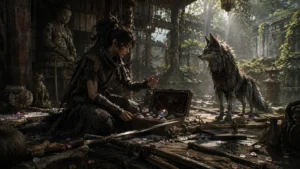
Consider an encounter involving two enemies positioned near a damaged structure.
A beginner could approach it in the following order:
- Examine the area for an elevated route.
- Use Emma’s plant ability to reach the higher position.
- Perform a falling assassination on the nearest enemy.
- Watch the remaining opponent’s attack animation.
- Parry the incoming strike.
- Use the generated points to command Koo.
- Attack while the enemy is disrupted.
- Move away before the opponent recovers.
This example combines traversal, stealth, parrying, companion commands and real-time sword attacks. It demonstrates why the game’s systems should be treated as one connected loop rather than isolated mechanics.
How Does Combat Differ From a Traditional Action RPG?
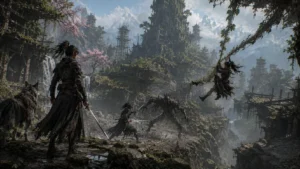
In many action RPGs, companion abilities are activated through simple shortcuts or controlled automatically. Beast of Reincarnation gives Koo a more deliberate role through its command interface.
The time slowdown allows players to think tactically without removing the need for real-time execution. Emma must still move, attack and parry accurately, but Koo’s command system provides an additional layer of decision-making.
The system may appeal to two types of players:
- Action fans who enjoy timing, swordplay and defensive precision
- RPG players who prefer choosing abilities and creating specialised builds
Neither side completely replaces the other.
Is Beast of Reincarnation an Open-World Game?
Official descriptions call it an expansive adventure and highlight broad exploration, changing landscapes and different regions. However, the publisher does not clearly classify it as a fully seamless open-world game in its primary description.
Players should therefore expect meaningful exploration without assuming that its structure follows the same format as every conventional open-world RPG.
What Skills and Progression Systems Are Included?
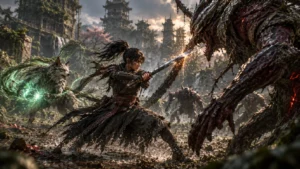
The confirmed progression systems include:
- Unique skill trees
- Equipment-based loadouts
- Spirit Stones
- Powers captured from defeated bosses
- Different ranged, stealth and aggressive approaches
Official sources do not present these systems as permanent character classes. Instead, the player defines a preferred style through the chosen combination of skills and equipment.
Progression is also connected to the story. Defeating bosses and capturing their powers forms part of Emma and Koo’s journey towards the Beast of Reincarnation.
What Is the Role of Exploration?
Exploration serves three main purposes.
First, it reveals the post-apocalyptic world and its changing environments. Second, it allows Emma to use her plant abilities to cross damaged terrain. Third, it creates tactical opportunities by placing her above, behind or away from enemies.
Players who move directly towards every objective may overlook routes that provide a safer approach to combat. Exploring the surrounding terrain before attacking can therefore be as valuable as upgrading a weapon or learning a new skill.
Final Takeaway
Beast of Reincarnation gameplay is built around the cooperation between Emma and Koo. Emma supplies the real-time movement, sword attacks and accurately timed parries, while Koo provides command-based techniques that introduce a more tactical RPG layer.
The key gameplay cycle can be summarised as:
Watch the enemy → parry the attack → generate points → command Koo → create an opening → attack with Emma.
Progression through skill trees, equipment and Spirit Stones allows that basic loop to support aggressive, ranged or stealth-focused playstyles. Emma’s plant powers also connect exploration with combat by opening routes, crossing damaged terrain and creating opportunities for falling assassinations.
Players who learn to combine positioning, parrying, Koo’s commands and carefully selected equipment will understand the game more quickly than those who approach it as a conventional sword-fighting title.
Frequently Asked Questions
What type of game is Beast of Reincarnation?
It is a single-player action RPG combining real-time sword fighting with command-based companion abilities.
Who are the main characters?
The main characters are Emma, an outcast affected by blight, and Koo, a blighted dog or malefact. Although they would ordinarily be enemies, they travel and fight together.
How do Koo’s abilities work?
Emma earns points by successfully parrying enemy attacks. Those points can then be spent through Koo’s command menu to activate his techniques. Opening the menu slows time while the player makes a selection.
Can Koo be controlled directly?
Koo’s techniques are issued through commands rather than through full direct character control. The player continues to control Emma during exploration and real-time combat.
Does Beast of Reincarnation have skill trees?
Yes. Official PlayStation and Fictions information confirms skill trees, gear and Spirit Stones as part of the loadout and progression system.
Can players use stealth?
Yes. The game supports stealth-focused loadouts, and Emma can use her plant-like hair to reach elevated positions and perform falling assassinations.
Is ranged combat available?
Yes. Ranged combat is one of the officially identified playstyles available through the loadout system.
When is Beast of Reincarnation set?
The story takes place in Japan in the year 4026, long after the world has been devastated by blight.
When was Beast of Reincarnation released in the UK?
The UK PlayStation and Xbox listings give a release date of 4 August 2026. Steam records the PC release as 3 August 2026, reflecting differences in regional storefront timing.
What platforms can run Beast of Reincarnation?
The game is available for PlayStation 5, Xbox Series X|S and PC through Steam. The Xbox version also supports Xbox Play Anywhere between Xbox consoles and PC.
Is Beast of Reincarnation on Xbox Game Pass?
Yes. Xbox states that the game is available through Game Pass and supports Xbox Play Anywhere. Subscription availability can change over time, so players should check the current Game Pass catalogue before downloading.
Is Beast of Reincarnation available on PS4 or Xbox One?
No PS4 or Xbox One versions are listed by Game Freak. The confirmed console platforms are PS5 and Xbox Series X|S.
What is the UK age rating?
The UK Xbox Store lists the game as PEGI 16 for violence. Parents and younger players should review the current rating information shown by the relevant storefront before purchasing.