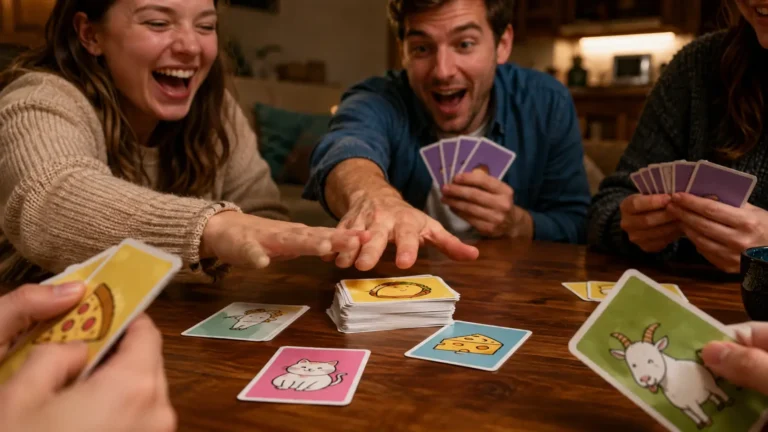

Dobble is a fast-paced, family-friendly card game built around visual perception and quick reflexes.
Whether you’re playing with children, friends, or competitive adults, understanding how to play Dobble and its five mini-games can turn a simple deck of cards into hours of fun.
In this guide, we’ll explore everything from the game’s origins to setup, game variations, rules, and strategies that will help you win more consistently.
What Is Dobble and Why Is It So Popular?
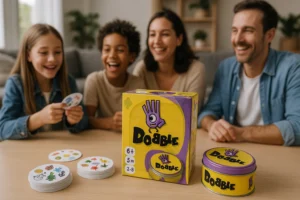
Dobble is a pattern recognition game where players race to identify the one matching symbol between any two cards. Each of the 55 cards in the deck features 8 symbols, selected from a pool of 50.
The clever design of the deck ensures that any two cards always share exactly one matching symbol, although it may vary in size or orientation.
The game has been widely acclaimed for its fast pace, accessibility, and appeal to a broad age range. With an average playtime of 15 minutes, it has become a family favourite.
In the UK, Dobble was the best-selling game in both 2018 and 2019, cementing its popularity across households, schools, and game nights.
Dobble is marketed under the name Spot It! in North America, but the gameplay and mechanics remain identical. The name ‘Dobble’ is derived from the word ‘double’, referring to the single shared match between cards.
Where Did Dobble Originate From?
The game’s underlying mechanics are based on a mathematical principle known as the finite projective plane. This structure ensures that each card pair shares one and only one matching element.
The origins trace back to 1976 when French mathematics enthusiast Jacques Cottereau created a card set featuring six insect images per card and a unique matching system.
In 2008, journalist and game designer Denis Blanchot discovered a few of these prototype cards and saw their potential. He developed them into what became Dobble.
The game was first released in France in 2009 and later expanded into the UK and North American markets in 2011. In 2015, publishing rights were acquired by French game company Asmodee.
The use of finite projective geometry is what makes Dobble mathematically elegant and mechanically consistent.
For example, with 8 symbols per card, the underlying formula suggests a theoretical maximum of 57 cards, although the final product uses 55 to suit standard production formats.
What Are the Official Rules of Dobble?
Each player must identify the common symbol between their card and a reference card. Once identified, the player must call out the symbol and either take the card, discard their own, or place it on another player, depending on the mini-game being played.
Basic Game Details:
| Feature | Description |
| Type | Matching game |
| Players | 2 to 8 |
| Age Range | 6+ (8+ for standard game) |
| Deck Size | 55 cards |
| Symbols per Card | 8 |
| Symbols in Deck | 50 |
| Average Duration | 15 minutes |
Players should sit in a circle with enough room to quickly place or take cards. Shuffling thoroughly is essential before gameplay begins to ensure fairness.
How to Play Dobble?
Dobble is designed to be fast, fun, and competitive. The goal across all its mini-games remains the same: find the matching symbol between two cards before anyone else. Every card shares exactly one identical symbol with any other card, making observation, memory, and quick reactions the key to success.
Dobble can be played in multiple ways, with each mini-game offering a slightly different objective and pace. Before playing, it’s essential to understand how to set up the cards correctly.
Game Setup
Step 1: Prepare the Deck
Start by thoroughly shuffling all 55 circular cards. The quality of the shuffle is important, as Dobble’s randomness makes every round unpredictable and fair. The symbols vary in size and orientation, which makes identifying matches challenging even for experienced players.
Ensure that the playing surface is clear and accessible to everyone, as players will need to react quickly to grab, discard, or pass cards during play.
Step 2: Select a Mini-Game
Dobble includes five official mini-games, each with its own set of rules but the same core mechanic. Players can decide which version to play first or run through all five in one sitting to create a complete Dobble session.
Below, each mini-game is explained in detail so players can choose the version that best fits their group’s size, skill level, and desired level of competition.
Mini Game 1: How Do You Play The Towering Inferno?
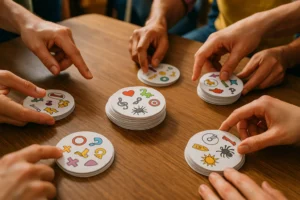
Objective: Collect the most cards by correctly spotting matching symbols faster than everyone else.
This is the most popular version of Dobble and often the first one new players try. It encourages speed and observation under pressure.
Step-by-step Guide:
- Deal one face-down card to each player.
- Place the remaining deck face-up in the centre as the draw pile.
- At the same time, all players flip over their personal cards.
- Everyone looks for the one matching symbol between their card and the top card in the central pile.
- The first player to correctly identify and shout the symbol takes the top central card and places it on top of their own pile.
- The card just won becomes their new reference card for the next round.
- Continue the process until there are no cards left in the draw pile.
The player who has collected the most cards by the end of the game wins.
This game is excellent for larger groups, as it creates a fast-paced, competitive environment where every player is racing to spot matches simultaneously. It tests both pattern recognition and reaction speed continuously.
Mini Game 2: How Do You Play The Well?
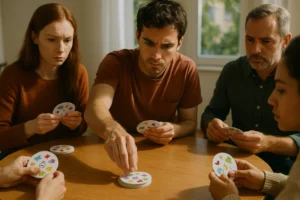
Objective: Be the first player to get rid of all your cards.
This mode flips the goal of The Towering Inferno by rewarding players who successfully discard their cards rather than collecting them.
Gameplay Instructions:
- Shuffle and distribute the entire deck evenly among players, face down. Each player forms a personal pile.
- Place one card face-up in the centre of the table.
- All players reveal the top card from their personal piles simultaneously.
- Everyone searches for the matching symbol between their card and the central card.
- When a player finds a match, they must announce the symbol aloud and place their card on top of the central pile.
- The central card now changes, creating a new match for the next player to find.
- The process continues rapidly until one player successfully discards all their cards.
That player wins the round. The last player holding cards is considered the loser.
This variation is particularly enjoyable for those who prefer fast, continuous gameplay and minimal downtime between turns.
Mini Game 3: How Do You Play The Hot Potato?

Objective: Get rid of your cards by passing them onto other players.
The Hot Potato version of Dobble adds direct interaction and intensity, making it a perfect party option for four or more players.
How to Play:
- Each player is dealt one face-down card.
- On a signal, all players flip their cards face-up at the same time.
- Players must quickly find a matching symbol between their card and any other player’s card.
- When a player finds a match, they say the symbol aloud and place their card on top of the other player’s pile.
- The player who receives a card must now continue playing with the new card on top of their pile.
- Play continues rapidly as players pass cards around by spotting matches.
After several rounds (typically five), the player who has accumulated the fewest cards is declared the winner.
Because of its high energy and constant player interaction, The Hot Potato is often the most chaotic and exciting version of Dobble, requiring quick decision-making and adaptability.
Mini Game 4: How Do You Play Gotta Catch Them All?

Objective: Collect as many cards as possible over several rounds.
This variation introduces a more strategic, round-based structure rather than continuous play.
Setup and Gameplay:
- Place one card face-up in the middle of the table.
- Deal one face-down card to each player.
- On the signal, players flip their cards and try to find the matching symbol between their card and the central card.
- When a player spots a match, they announce the symbol and take the matched card either their own or an opponent’s.
- The central card remains in play until every outer card has been matched.
When all outer cards are collected, a new round begins using a new central card.
Players retain any cards they win between rounds. The game continues until the deck is empty, and the player who has collected the most cards overall is declared the winner.
This mode rewards strategic observation and timing, making it suitable for players who enjoy planning over pure speed.
Mini Game 5: How Do You Play The Poisoned Gift?

Objective: Finish the game with the fewest cards possible.
This is the most tactical and often mischievous mini-game in Dobble, as players actively try to give cards to others.
Gameplay Instructions:
- Deal one face-down card to each player.
- Place the remaining deck face-up in the centre.
- On the signal, everyone flips their cards face-up.
- Players look for a matching symbol between the central card and another player’s card—not their own.
- Once a match is identified, the player calls out the symbol and places the central card on the matching player’s pile.
- A new central card is drawn, and the process repeats.
The game continues until all cards from the central pile have been played. The winner is the player with the fewest cards remaining in front of them.
This version introduces a clever twist by encouraging players to observe everyone’s cards instead of focusing on their own. It can lead to strategic decisions, bluffs, and plenty of laughter, as players try to avoid being targeted.
Summary of All Dobble Mini-Games:
| Mini-Game | Objective | Key Skill Tested | Suitable Players |
| The Towering Inferno | Collect the most cards | Speed and attention | 2–8 |
| The Well | Discard all cards first | Fast reactions | 2–8 |
| The Hot Potato | Pass cards to opponents | Reflexes and awareness | 3–8 |
| Gotta Catch Them All | Gather as many cards as possible | Strategy and timing | 2–6 |
| The Poisoned Gift | End with the fewest cards | Tactical observation | 3–8 |
What Are Some Extra Rules to Know in Dobble?
- If two players call out the matching symbol at the same time, the one who physically takes or discards the card first gets the point.
- In case of a tie, a “duel” round can be played where two players each draw a card and try to identify the match between them.
- Symbols can vary in size and may be rotated, which adds an additional challenge.
- House rules can be created for custom mini-games or added penalties.
Can You Play Dobble with Younger Children?
Dobble is well-suited for children, especially with the Dobble Kids edition that uses fewer and more recognisable symbols. Parents and teachers often use it to develop early skills such as:
- Visual recognition
- Focus and attention span
- Hand-eye coordination
Simpler mini-games like The Well or The Towering Inferno are especially good for children aged 4 to 6.
What Strategies Help You Win at Dobble?
Quick reflexes and visual memory are the foundations of winning at Dobble, but there are some useful strategies.
Winning Tips for Dobble
| Strategy | Description |
| Familiarise with Symbols | Memorise the symbol set to speed up recognition |
| Focus on the Whole Card | Scan the card holistically rather than looking for one shape |
| Use Hand Positioning | Keep hands near the central pile to grab cards quickly |
| Avoid Overthinking | React instinctively rather than logically analysing matches |
Solo practice can also improve performance, especially in sharpening recognition speed. Over time, players develop subconscious scanning patterns that help them spot matches almost instantly.
What Are Some Dobble Game Variations You Can Try?
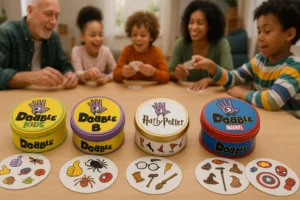
Dobble’s mechanics are flexible enough to allow for several interesting variations beyond the official mini-games.
- Themed Decks: Try editions like Dobble Harry Potter, Dobble Animals or Beach Edition for themed play.
- Team Play: Players are split into teams and take turns to compete for card matches.
- Tournament Format: Create a bracket system and have players face off in one-on-one duels. Winners move on to the next round until a final champion is declared. This format works particularly well for larger groups at parties or events.
- Speed Mode: Introduce a timer for each round. Players must find the matching symbol within a strict time limit, or forfeit the round. This version adds pressure and increases the competitive intensity.
- Silent Dobble: For an added twist, play without speaking. Players must use gestures or simply grab the card when they find a match. This variation increases the difficulty and adds an extra layer of focus.
- Memory Mode: After players briefly view the cards, they are flipped face-down. Players then try to recall and find matches from memory. This is especially useful for educational or cognitive training purposes.
These variations keep the game fresh and adaptable, ensuring that Dobble remains engaging even after many sessions.
Comparison of All Dobble Mini-Games
| Mini-Game | Objective | Ideal Player Count | Skill Focus |
| The Towering Inferno | Collect the most cards | 2–8 | Speed and observation |
| The Well | Discard all cards first | 2–8 | Quick reactions |
| The Hot Potato | Pass cards to opponents quickly | 3–8 | Interpersonal speed |
| Gotta Catch Them All | Collect as many cards as possible | 2–6 | Strategic recognition |
| The Poisoned Gift | Finish with the fewest cards | 3–8 | Defensive tactics |
Each of these mini-games offers a distinct style of play, making Dobble versatile for different group dynamics and age ranges.
Conclusion
Dobble’s fast, intuitive gameplay and short playtime make it an ideal game for family nights, classroom activities, or parties.
With multiple game modes and the same core mechanic, it offers fresh excitement each time you play.
Whether you’re trying to outmatch your siblings or sharpen your mind, Dobble is a smart and simple game that delivers fun without fuss.
Frequently Asked Questions About How to Play Dobble
What age is Dobble suitable for?
Dobble is generally suitable for ages 6 and above, with a junior version available for younger players.
How long does it take to play one Dobble game?
Each mini-game takes approximately 10–15 minutes, making it ideal for short sessions.
How many symbols are there in Dobble?
There are 50 different symbols in the standard version, with 8 appearing on each card.
Is Dobble a game of skill or luck?
While some mini-games involve random distribution, the core mechanic relies heavily on visual speed and pattern recognition.
Can Dobble be played solo?
Yes, practicing solo can help improve symbol recognition and speed, though the game is designed for 2–8 players.
What’s the difference between Dobble and Spot It!?
They are the same game. Dobble is the name used in Europe, and Spot It! is the name used in North America.
Can you create custom Dobble decks?
Some platforms allow for custom Dobble decks, which are useful for educational purposes or themed events.