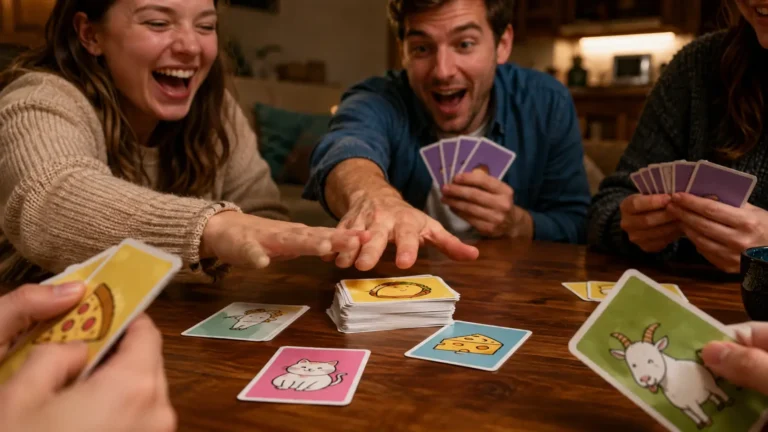

Scabby Queen is a classic British card game that combines chance, suspense and light-hearted fun.
Played with a standard deck, the goal is to discard matching pairs and avoid ending up with the dreaded Queen of Spades.
Its simple rules and quick pace make it ideal for both children and adults. In this guide, you’ll learn everything from setup and gameplay to variations and strategies, helping you master Scabby Queen and enjoy this timeless game with friends or family.
What is Scabby Queen and Why is it Popular?
Scabby Queen is a traditional British shedding card game where the objective is to avoid being the last player left with the unmatched Queen of Spades.
The game is particularly well-loved because of its suspenseful gameplay and simple structure, making it accessible to players of nearly all ages.
Typically requiring only a standard deck of cards and a few participants, it’s often played in family settings, classrooms and casual gatherings.
It encourages observation, memory, and the ability to bluff or hide emotions during play. These qualities have helped the game remain popular in homes and schools across the UK for generations.
It is a social game that doesn’t require a board, scoring system or specialised cards. The absence of complex strategies or point tracking ensures players can focus entirely on the excitement of gameplay and interpersonal interaction.
Where Did the Scabby Queen Card Game Come From?
Scabby Queen has its roots in early 19th-century card games. The game’s earliest known written rules were published by Eliza Leslie in 1831 in the United States and later in 1835 in England.
It was presented under different titles depending on gender norms of the time: Old Maid for girls and Old Bachelor for boys.
The game may have derived from the German card game Black Peter, with rules dating back to 1821. A similar game, Vieux Garçon, appeared in French texts in 1853.
These games likely stem from older drinking games where the loser was determined by being left with a specific card and was required to pay for the next round.
Originally, a standard 32- or 52-card French-suited deck was used. The unmatched card was often the queen of diamonds or jack of spades, and the unfortunate player holding it was dubbed the “Old Maid”, “Vieux Garçon”, or “Black Peter”.
The term “Old Maid” existed before the card game, describing an unmarried or childless woman, seen at the time as the female equivalent of an “old bachelor”.
The game declined during the mid-1800s but made a comeback in the 1880s. In England, its revival was helped by the release of proprietary decks like Merry Matches, published in 1883 by Wyman & Sons of London.
This version replaced standard cards with nursery rhyme characters, making it especially popular among children.
What Are the Rules of Scabby Queen?
Scabby Queen is primarily a game of avoidance. The goal is simple: discard all matching pairs and do not be the last player left with the Queen of Spades.
Basic rules include:
- Use a standard 52-card deck
- Remove one Queen (commonly the Queen of Clubs), leaving the Queen of Spades unmatched
- Distribute the remaining cards evenly among all players
- Remove all matching pairs of the same rank from your hand
- Players take turns drawing a card from the player to their left
- The player who ends the game holding the Queen of Spades loses
This structure makes the game fast-paced and easy to understand, even for younger players.
How Do You Play Scabby Queen?
Scabby Queen is played in distinct stages that guide players from preparation to gameplay and finally to identifying the losing player.
Understanding these phases ensures the game runs smoothly and remains entertaining for everyone involved.
Game Setup
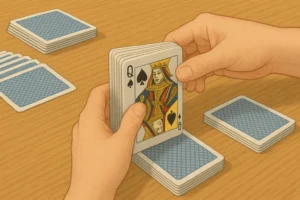
The first part of Scabby Queen involves preparing the deck correctly and dealing the cards to all players.
Step 1: Preparing the Deck
Begin by using a standard 52-card pack. Remove both Jokers, as they are not used in the game.
Next, take out one of the Queens most commonly the Queen of Clubs which leaves the Queen of Spades unmatched. This unmatched card becomes the Scabby Queen.
Step 2: Choosing a Dealer
To select a dealer, each player cuts the deck. The player with the highest card becomes the dealer for that round. The dealer shuffles the remaining cards thoroughly before proceeding.
Step 3: Dealing the Cards
The dealer distributes the cards one at a time to each player in a clockwise direction. If the number of cards does not divide evenly, a few players may end up with one card more than others, which is acceptable and doesn’t affect gameplay. Each player holds their cards privately and does not reveal them to others.
Getting Started
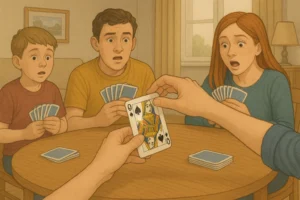
Once the cards are dealt, the next stage involves preparing each hand by discarding any pairs of matching rank and initiating the draw process.
Step 4: Removing Matching Pairs
Players examine their hands to identify any pairs of the same rank, such as two 10s or two Jacks. These matching pairs are immediately discarded face down into a common discard pile. Suits do not matter for matching only the card values must match. The Queen of Spades cannot be paired and must remain in the game.
This initial discarding phase reduces the number of cards in play and sets the stage for the draw process.
Step 5: Starting the Draw
The dealer offers their remaining hand, face down, to the player on their left. Without looking, the next player selects one card at random. If the card drawn forms a new pair with any card already in their hand, the player discards the pair immediately. If it does not form a pair, the card is simply added to the player’s hand.
Once this action is completed, the player who just drew a card offers their hand to the next person on their left, and the process continues clockwise around the table.
Gameplay Steps
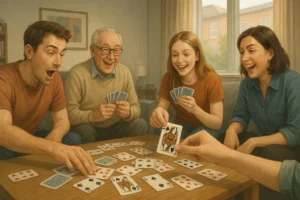
The main part of the game involves repeated drawing and discarding, during which players try to avoid picking or keeping the Queen of Spades.
Step 6: Continuing Play Around the Table
As each player draws a card from the person to their left, the cycle of pairing and discarding continues. Any new pairs formed are placed into the discard pile. If no pair is formed, the player retains the card. The goal is to get rid of all cards in hand by forming pairs.
Players who successfully discard all their cards are considered out of the game and safe from becoming the final loser. They no longer take part in drawing or offering cards but may remain to observe or manage penalties.
Step 7: The Queen Changes Hands
Throughout the game, the Queen of Spades passes from one player to another, often without anyone knowing who currently holds it. Players may choose to bluff or mask their reactions when they draw or pass the Queen, creating an additional layer of suspense.
The tension builds as the number of remaining cards decreases and the chance of being left with the Scabby Queen grows. Players often try to recall who drew which cards and use their memory to avoid choosing the Queen.
Step 8: Ending the Game
Eventually, all pairs will have been discarded, and only one card remains in play the Queen of Spades. The last player holding this unmatchable card becomes the loser of the game. There is no ultimate winner, as all other players have succeeded by discarding their cards.
This final moment often comes suddenly, especially in larger games where tracking the Queen is more challenging.
Winning or Losing

Although Scabby Queen focuses on identifying a loser rather than a winner, the end of the game can still be structured to reward players and introduce optional penalties for added enjoyment.
Step 9: Identifying the Loser
Once the Queen of Spades is the only card left in a player’s hand, that player is declared the loser. All other players are considered to have avoided the Scabby Queen and are therefore “safe”.
Step 10: Adding Optional Penalties or Rewards
To make the game more engaging, some groups introduce light-hearted forfeits or small rewards.
- The player left with the Queen may be required to perform a silly task, such as telling a joke or singing a song.
- Alternatively, the first player to discard all their cards might be rewarded with a small prize or be given the honour of dealing the next round.
These elements can be customised depending on whether children or adults are playing, and they help enhance the overall experience.
Table: Step-by-Step Gameplay Breakdown
| Step | Phase | Description |
| 1 | Prepare the Deck | Remove Jokers and one Queen, leaving Queen of Spades unmatched |
| 2 | Choose a Dealer | Players cut the deck; highest card becomes dealer |
| 3 | Deal the Cards | Deal all cards evenly in a clockwise direction |
| 4 | Remove Matching Pairs | Players discard any pairs of equal rank |
| 5 | Begin Drawing | Players draw one card from the left and check for new pairs |
| 6 | Continue Around Table | Repeat drawing, pairing, and discarding clockwise |
| 7 | Watch the Queen | Queen of Spades is secretly passed between players |
| 8 | Final Round | All pairs discarded, one card remains the Queen |
| 9 | Determine the Loser | Player left with Queen of Spades loses the game |
| 10 | Optional Forfeits | Penalties or rewards can be added for extra fun |
Are There Any Fun Variations of Scabby Queen?
Scabby Queen has evolved over the years into various playful and creative versions that keep the game fresh and entertaining for different age groups and settings.
While the original version focuses on avoiding the Queen of Spades, the core gameplay can easily be adapted with minor rule changes, alternative cards, or humorous twists.
Variations are often introduced to suit the group playing whether it’s children looking for colourful themes, adults interested in higher stakes, or families wanting a new challenge.
Random Card Removal
In this version, instead of deliberately removing the Queen of Clubs, one card is removed at random and placed face down without revealing it. This increases the difficulty because no one knows which card is unmatched. Players must rely on memory and deduction as the game progresses.
- Increases suspense
- Suitable for older children and adults
- Makes bluffing more strategic
Joker as the Old Maid
Instead of removing a Queen, a Joker is added to the deck and used as the unmatched card. This makes it visually stand out, especially in custom or themed decks, and gives the game a slightly different character.
- Joker becomes the card to avoid
- Easy to spot but hard to track once shuffled
- Great for themed decks or novelty cards
Suit Colour Matching
This version increases the difficulty of forming pairs. Players can only discard pairs that match both rank and suit colour. For example, a 7 of Hearts can only pair with a 7 of Diamonds (both red), and a 10 of Spades can only pair with a 10 of Clubs (both black).
- Increases the challenge
- Encourages more strategic play
- Ideal for older players
Merry Matches Variant
Inspired by the 1883 card game “Merry Matches”, this version uses illustrated or themed cards, often with characters or pairs based on nursery rhymes, professions, or fairy tales. The odd card (such as Mistress Mary) becomes the undesirable card, replacing the Queen of Spades.
- Highly visual and engaging for children
- Introduces character-based storytelling
- Can include multiple mini-objectives such as collecting themed pairs
Old Maid Purgatory
A humorous rule where a player ends up with only one card but cannot discard or draw any further. The game cannot end until that player is eliminated, creating a “purgatory” situation. This variation adds tension and can lead to fun moments of frustration and laughter.
- Adds unexpected twists
- Prolongs the final stages of the game
- Best played with groups familiar with the original rules
Post-Draw Discarding Rule
In this variation, players may only discard new pairs after the next player has drawn a card from them. This can change the order of decision-making and prevent players from discarding too quickly.
- Slightly shifts the timing of gameplay
- Adds complexity to turns
- Can be used to balance faster games
Common Variations of Scabby Queen
| Variation Name | Key Rule Change | Ideal For |
| Random Card Removal | Remove one card at random, hidden from all players | Adults, experienced players |
| Joker as Old Maid | Joker added as unmatched card | Families, novelty decks |
| Suit Colour Matching | Only pairs of same rank and suit colour allowed | Teens and adults |
| Merry Matches | Use illustrated or themed cards; unmatched character loses | Children, storytelling games |
| Old Maid Purgatory | A player stuck with one card cannot draw or discard | Humorous, social groups |
| Post-Draw Discarding | Players discard only after someone has drawn from them | Competitive players |
These variations offer flexibility in how the game is played and provide options to adjust difficulty, pace, or thematic engagement. Whether you’re playing with young children or a group of adults, you can customise the rules to match the mood of the game and keep things fresh with every round.
What Tips Help You Avoid the Queen of Spades?
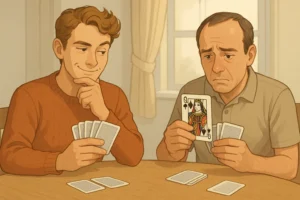
Although Scabby Queen is primarily a game of luck, a few strategies can increase your chances of staying safe:
- Observe players’ reactions when they pick a card. If someone reacts subtly, it could mean they picked the Queen
- Try not to make it obvious if you hold the Queen yourself. Avoid hesitation or nervous behaviour
- Keep track of cards that are being discarded. If many pairs of a certain rank are gone, the remaining ones are likely unmatched
- In smaller groups, try to remember what cards have been drawn and discarded
Strategic bluffing, poker-faced reactions, and a good memory are your best tools for avoiding the Queen.
Can Kids Play Scabby Queen Safely?
Scabby Queen is well-suited for children, especially those between the ages of 4 and 10. It is often used in educational environments and family gatherings because of its simplicity and focus on matching skills.
To make it even more child-friendly:
- Use decks with large fonts or images
- Replace penalties with fun or silly challenges
- Keep the rules simple by allowing any matching rank as a pair
- Avoid competitive pressure by making it about fun rather than winning
The game helps children develop focus, pattern recognition and social interaction in a relaxed setting.
How Does Scabby Queen Compare to Other Card Games?
Scabby Queen shares similarities with other traditional card games but also has key differences.
- Old Maid: Nearly identical in rules, Old Maid is the American version of Scabby Queen. The only difference is the name and sometimes the unmatched card.
- Black Peter: A European counterpart often played with specially designed cards. The losing player might get a smudge of soot as a playful punishment.
- Go Fish: Unlike Scabby Queen, Go Fish is based on asking for cards and making sets, requiring more active memory but less bluffing.
Scabby Queen stands out for its suspense, unpredictability and the comical tension of passing the Queen. It’s less about collecting and more about avoiding the final unmatched card.
Scabby Queen shares similarities with other traditional card games but also has several key differences. Players interested in discovering more card games, gaming guides and the latest industry coverage can also explore Gaming Mag for further gaming content.
Conclusion
Scabby Queen remains a timeless and engaging card game with simple rules and universal appeal. Whether played casually among friends, as a fun classroom activity, or during family gatherings, it guarantees suspense, laughter, and memorable moments.
With just a deck of cards and a few players, you’re set for an evening of bluffing, giggles, and light-hearted tension just don’t be the one left holding the Scabby Queen!
FAQs About Scabby Queen
What happens if two players end with one card each?
This rarely happens, but if both are left with unmatched cards, verify whether a card was missed or misplayed. Reset or reshuffle if needed.
Can Scabby Queen be played with Jokers?
Yes. Adding a Joker can act as the unmatchable card, offering a variation to the standard rule.
How many players can play Scabby Queen?
Anywhere between 2 to 12 players. The more players, the more unpredictable and fun the game becomes.
Is there a printable version of Scabby Queen rules?
Yes. Many educational sites and gaming blogs offer printable rule sheets for classroom or home use.
Can I make my own variations of Scabby Queen?
Definitely. Customise the rules, penalties, or card themes to suit your audience and age group.
What happens if someone cheats?
Players caught cheating may receive a playful penalty or be disqualified all in good fun.
Is Scabby Queen suitable for classroom games?
Yes, especially for young children. It helps build cognitive and social skills in an engaging way.