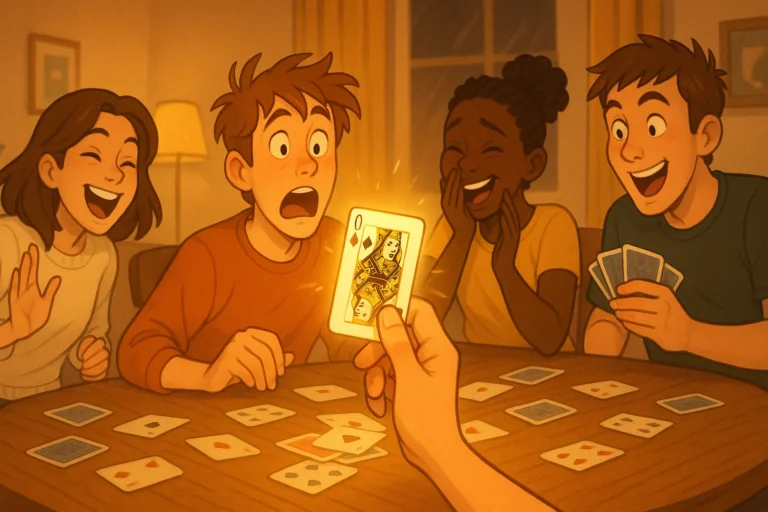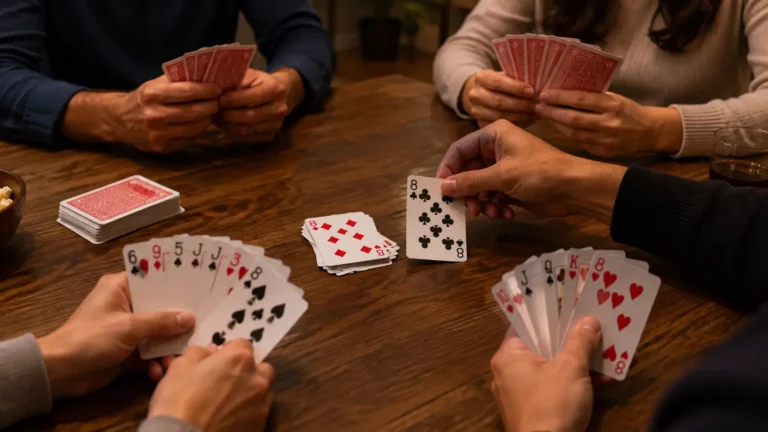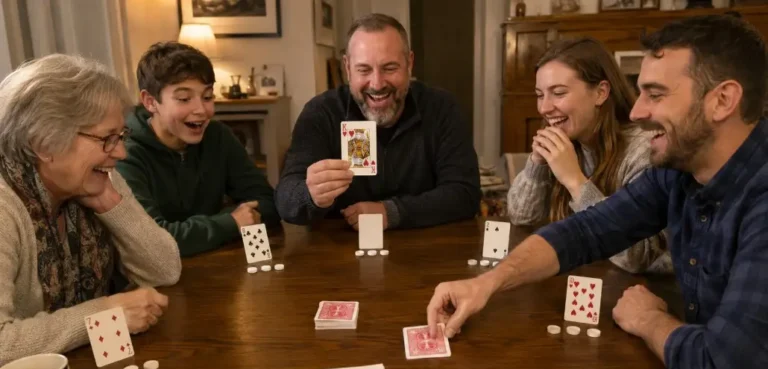

Taco Cat Goat Cheese Pizza is a fast-paced card game that tests your attention, memory and reactions. You take turns revealing cards while saying “Taco”, “Cat”, “Goat”, “Cheese” and “Pizza” in order, regardless of the picture shown.
When the spoken word matches the revealed card, everyone races to slap the central pile, and the last player must collect it. Special Gorilla, Groundhog and Narwhal cards add extra actions.
This guide explains the setup, turn sequence, penalties, special cards and exact winning rule in a clear, beginner-friendly way for new players.
What Is the Aim of Taco Cat Goat Cheese Pizza?
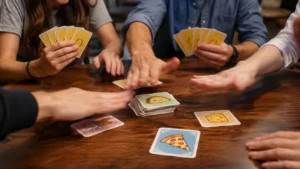
Your aim is to get rid of every card in your face-down personal pile and then win a valid slap. The official rules summarise the objective as: “Get rid of all your cards and be the FIRST to slap your hand on the central pile.”
There are therefore two parts to winning:
- Play every card from your individual pile.
- Make the first correct slap after a match or special card appears.
You do not win immediately when your final card reaches the centre. You remain involved in the word sequence and continue reacting to matches and special cards until you complete the winning slap.
This distinction matters because a cardless player can still make an incorrect slap or finish last. In either case, that player may collect the central pile and lose the advantage of having no cards.
What Do You Need Before Starting the Game?
The standard game uses a dedicated deck containing 64 cards. It supports two to eight players, is marked for ages eight and over, and has an estimated playing time of approximately 10 minutes.
You also need a stable table or another flat surface. Everyone should be able to reach the centre comfortably without leaning across another player.
Game At A Glance
| Feature | Standard Game Information |
| Number of players | 2–8 |
| Recommended age | 8+ |
| Approximate duration | 10 minutes |
| Number of cards | 64 |
| Normal card types | Taco, Cat, Goat, Cheese and Pizza |
| Special card types | Gorilla, Groundhog and Narwhal |
| Main mechanic | Match the spoken word to the revealed card |
| Winning condition | Empty your pile and win a correct slap |
The five normal pictures create word-and-card matches, while the three special cards interrupt the regular pattern with actions.
How Do You Set Up Taco Cat Goat Cheese Pizza?
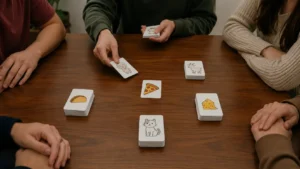
This guide primarily follows the edition that uses fixed card quantities according to the number of players. Before dealing, clear enough space in the middle of the table for one shared face-up pile.
How Should You Shuffle and Deal the Cards?
Shuffle the 64-card deck thoroughly. Deal each person the required number of cards face down, placing any unused cards back in the box.
Card Distribution By Player Count
| Number of Players | Cards Per Player | Remaining Cards |
| 2–5 | 12 | Return to the box |
| 6 | 10 | Return to the box |
| 7–8 | 8 | Return to the box |
These quantities appear in the complete English rules booklet for this edition.
Do not look at your cards while receiving or arranging them. Knowing what comes next would give you an unfair advantage in a game built around simultaneous recognition.
Preparing the Playing Area
Place your cards face down in one personal pile in front of you. The middle of the table becomes the central pile, where every revealed card will be placed face up.
In the fixed-distribution edition, the dealer begins the first round and play proceeds clockwise. The dealer reveals the first card while saying “Taco”; the next player reveals a card while saying “Cat”.
Do not hold a hand over the centre while waiting. Keeping hands an equal distance from the pile makes the slapping races fairer.
How Do You Play Taco Cat Goat Cheese Pizza Step by Step?
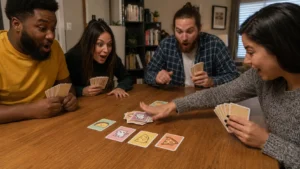
Every turn in Taco Cat Goat Cheese Pizza combines two actions: revealing a card and saying one word from the fixed sequence.
The spoken word does not change to match the card in your hand. Instead, you must keep following the order Taco, Cat, Goat, Cheese and Pizza, regardless of which picture appears.
The main challenge is to listen to the spoken word while watching the revealed card. When the two match, everyone must react immediately and slap the central pile.
Step 1: Take the Top Card From Your Personal Pile
At the beginning of your turn, take only the top card from your face-down pile. You must not search through the cards, rearrange them or check which picture is coming next.
Your personal pile should remain face down throughout the game. This ensures that every card reveal is unexpected and that all players have the same opportunity to recognise a match.
Keep the remaining cards neatly stacked in front of you so that it is clear which card should be played next.
Step 2: Flip the Card Outwards Into the Centre
Turn the card face up and place it on top of the central pile. The card should be flipped outwards, away from your face, rather than turned towards you.
This method helps prevent you from seeing the card before everyone else. Ideally, the other players should see the picture at the same time as you, or slightly before you do.
Do not slowly lift the card or pause to inspect it. Reveal it in one smooth movement and place it directly in the centre where everyone can see it.
Step 3: Say the Correct Word While Revealing the Card
As you reveal the card, say the next word in the repeating sequence. The spoken word and the card should appear at roughly the same time.
The first word is usually “Taco”. The next player says “Cat”, followed by “Goat”, “Cheese” and “Pizza”.
It is important to say the required word even when the picture on the card is different. For example, you may need to say “Taco” while revealing a Narwhal, Cat or Cheese card.
You should not name the picture you see unless that picture happens to match the correct word in the sequence.
Step 4: Keep Following the Five-Word Sequence
The word order always remains:
Taco → Cat → Goat → Cheese → Pizza
Each player says one word during their turn. The sequence continues around the table in clockwise order.
For example:
- The first player says “Taco”.
- The second player says “Cat”.
- The third player says “Goat”.
- The fourth player says “Cheese”.
- The next player says “Pizza”.
The sequence is based on the order of turns, not on the cards being revealed. This means players must remember the next word even when the pictures are distracting.
Saying the wrong word may result in a penalty, so everyone should listen carefully throughout the round.
Step 5: Return to “Taco” After “Pizza”
The word sequence does not stop after “Pizza”. Instead, it begins again immediately with “Taco”.
For example, if one player reveals a card and says “Pizza”, the next player must reveal their card while saying “Taco”. The following player then says “Cat”.
This repeating cycle continues until a match or special card causes players to slap the central pile and the round ends.
After a player collects the pile, the new round also begins with “Taco”, regardless of which word was spoken before the slap.
Step 6: Compare the Spoken Word With the Revealed Card
As soon as a card is placed in the centre, compare the word spoken with the picture on that card.
A normal match occurs only when the two are identical. Examples include:
- A player says “Taco” and reveals a Taco card.
- A player says “Cat” and reveals a Cat card.
- A player says “Goat” and reveals a Goat card.
- A player says “Cheese” and reveals a Cheese card.
- A player says “Pizza” and reveals a Pizza card.
The match is based only on the word being spoken and the newest card on the pile. Earlier cards do not create a match.
For example, if a Pizza card is already visible and the next player says “Pizza” while revealing a Goat card, there is no match. The newest card is Goat, so play continues.
Step 7: Continue Immediately When There Is No Match
When the spoken word and revealed picture are different, nobody should slap the pile. The next player should take their turn without unnecessary delay.
Suppose you say “Goat” and reveal a Cheese card. Because “Goat” and “Cheese” are different, no one reacts. The next player then reveals a card while saying “Cheese”.
Maintaining a steady rhythm makes the game more challenging. Long pauses can make matches too easy to predict and may disrupt the flow of play.
Players should therefore be ready before their turns and know which word comes next.
Step 8: Slap the Central Pile When There Is a Match
When the spoken word matches the newly revealed card, every player must try to slap the central pile as quickly as possible.
For example, imagine that you say “Cheese” and reveal a Cheese card. The match is immediate, so everyone should reach for the cards in the centre.
Players do not take turns when slapping. Everyone reacts at the same time, including the player who revealed the matching card.
The aim is not simply to touch the table near the cards. Your hand must reach the central pile according to the rules agreed by the group.
Players should avoid striking the table forcefully. A quick, flat-handed touch is enough to show who reacted first and who arrived last.
Step 9: Identify the Last Player to Slap
The last player to place a hand on the central pile loses that slap. In most cases, the last player’s hand will be on top of the other hands.
That player must collect all the cards in the centre, including the matching card that caused the slap.
When the order is unclear, players should check the hand positions calmly. The aim is to keep the game moving rather than allow a disputed slap to interrupt the round.
A player may also lose the round by slapping at the wrong time, flinching towards the pile or making another penalised mistake.
Step 10: Add the Collected Cards Beneath the Personal Pile
The player who loses the slap gathers every card from the centre. These cards are turned face down and placed underneath that player’s personal pile.
They should not be shuffled into the pile or examined before being added. Placing them at the bottom means they will return to play only after the cards already remaining in that player’s pile.
Collecting the central pile moves the player further away from winning because they now have more cards to discard.
Step 11: Start the New Round With “Taco”
The player who collected the cards begins the next round. They reveal the top card from their personal pile and say “Taco”.
The next player then says “Cat”, and the normal sequence continues clockwise.
The spoken sequence always resets after the pile has been collected. Players should not continue from the word that followed the previous card.
For example, even if the match occurred when someone said “Cheese”, the new round does not begin with “Pizza”. It restarts with “Taco”.
Step 12: Repeat the Process Until Someone Can Win
Continue revealing cards, following the spoken sequence and reacting to matches. Over time, players will either reduce their personal piles or collect more cards after losing slap rounds.
When you play your final card, you do not automatically win. You remain involved in the game, continue saying the correct word when your turn arrives and keep reacting to matches and special cards.
To win, you must have no cards remaining and then become the first player to complete a correct slap. Until that happens, you are still at risk of collecting the central pile and returning to the game with cards.
When Should You Slap the Central Pile?
You slap the central pile when the spoken word matches the card that has just been revealed. A Pizza card played while someone says “Pizza”, for example, creates a valid match.
A normal slap is not triggered merely because:
- Two identical pictures appear consecutively.
- The new card matches the previous card.
- A player says the name of another visible card.
- Someone hesitates or appears ready to slap.
- The revealed picture resembles a different item.
You must focus on the relationship between the current spoken word and the new top card. Older cards beneath it no longer determine whether a normal match has occurred.
The last hand added to the stack of hands loses the race. In most cases, the uppermost hand is therefore the last one placed, although players should resolve genuinely unclear finishes calmly.
Special cards are the only regular exception to the word-matching requirement. They trigger their actions as soon as they appear.
What Do the Special Cards Mean?
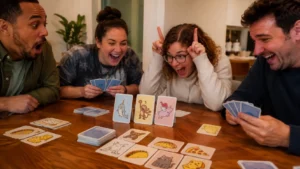
The three special cards are Gorilla, Groundhog and Narwhal. Whenever one is revealed, all players must complete its action and then slap the central pile, regardless of which word was spoken.
Gorilla, Groundhog and Narwhal Actions
A Gorilla requires you to beat your chest before slapping. A Groundhog requires you to knock on the table with both hands, while a Narwhal requires you to bring your hands together above your head to form a horn before reaching for the pile.
The correct order is always:
- Recognise the special card.
- Complete its required movement.
- Slap the central pile.
The last person to complete the action and slap collects the cards. A player who performs the wrong movement may also be penalised.
What Happens If You Perform the Wrong Action?
If you begin the wrong action, correct it before slapping whenever the edition’s instructions allow this. Slapping after an uncorrected action means you have not completed the special card properly and must collect the pile.
The downloadable manufacturer game instructions state that an incorrect action must be corrected before the slap. They also confirm that the final player to slap takes the cards.
Accuracy should come before speed. A fast slap does not count if the required movement was missed or performed incorrectly.
Do Special Cards Need to Match Spoken Words?
No. A special card activates because of its picture, not because it matches the chant.
Suppose you say “Cat” while revealing a Gorilla. Everyone must beat their chest and then slap, even though “Cat” does not match “Gorilla”. The word sequence still continues normally unless the round ends because someone collects the pile.
This rule prevents players from ignoring a special card simply because they were concentrating on the five-word sequence.
Which Mistakes Make You Pick Up the Pile?
You normally collect the central pile when you lose a slap, but several rule violations can produce the same penalty.
- Slapping when no match or special card has appeared.
- Starting an incorrect slap and pulling your hand back.
- Saying the wrong word in the sequence.
- Forgetting that it is your turn.
- Breaking the game’s steady playing rhythm.
- Looking at your card before revealing it.
- Turning a card towards yourself instead of outwards.
- Performing the wrong special-card action.
- Slapping before completing a special-card action.
An attempted false slap is commonly called a flinch. Even if your hand never touches the pile, visibly beginning the movement and stopping can cause you to forfeit the round.
Players must also reveal cards outwards so everyone else can see the face at the same time or slightly before the active player. Clearly peeking before placing the card results in collecting the central pile.
Because the game involves rapid hand movements and contact around a shared pile, remove sharp jewellery and avoid forceful downward strikes. The official instructions include the warning:
“Game involves physical contact. Play at your own risk.”
For younger or less experienced groups, agree on a slightly slower rhythm before starting. That adjustment can improve accessibility without changing what creates a match.
How Do You Win Taco Cat Goat Cheese Pizza?
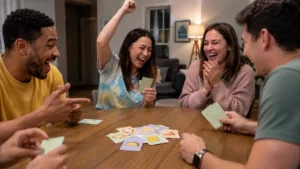
You win by having no cards left and then becoming the first player to make a correct slap after either a match or a special card. Emptying your pile alone does not finish the game.
Running Out of Cards
After playing your final card, you remain in the turn order. When your turn arrives, say the correct word in the sequence even though you have no card to reveal.
You must continue to:
- Follow the five-word chant.
- Watch the cards played by everyone else.
- Complete every special-card action.
- Slap whenever a valid trigger appears.
- Avoid flinching and other penalties.
Failing to recognise your turn can result in taking the central pile, which returns you to active card play.
How Do You Complete the Final Winning Slap?
Wait until a normal word-and-card match occurs or a special card is revealed. You must then be the first person to slap correctly; for a special card, that means performing its action before slapping.
If another player slaps first, the game continues and you remain cardless. If you slap last, flinch or make another penalised mistake, you may collect the central pile and must work through those cards again.
The final-slap requirement keeps the ending competitive. A player with no cards cannot simply stop paying attention and wait for everyone else to finish.
Conclusion
Learning how to play Taco Cat Goat Cheese Pizza is straightforward once you separate the chant from the pictures. Say Taco, Cat, Goat, Cheese and Pizza in order, slap when the word matches the newly revealed card, and complete the correct movement whenever a special card appears.
The last player to slap or the person who makes a penalised mistake collects the central pile. Most importantly, playing your final card is only the first part of winning—you must still complete the first correct slap while your personal pile is empty.
Frequently Asked Questions
Can Younger Children Play Taco Cat Goat Cheese Pizza?
The published age recommendation is eight years and over. Younger children may find it easier if the group practises the chant and special actions at a slower pace first.
Can You Look Through Your Personal Card Pile?
No, your personal pile must remain face down throughout the game. You reveal only the top card on your turn and should flip it outwards without peeking.
What Happens After Someone Collects the Central Pile?
That player places the collected cards face down beneath their personal pile. They then start the new round by playing a card and saying “Taco”.
Can You Use One Hand or Two Hands to Slap?
The ordinary match rule requires a hand to be placed on the pile, while some special actions explicitly use both hands. Players can agree before starting which hand may be used for the final slap, provided the rule applies equally to everyone.
What Happens When Two Players Slap at the Same Time?
The player whose hand is higher in the hand stack has usually arrived later. When the order cannot be determined fairly, the group should agree on a neutral replay rather than arguing over an uncertain result.
Can You Pause the Spoken Sequence Between Rounds?
A brief pause may be used to gather the cards and make the table safe. The new round then restarts with “Taco”, and the steady rhythm resumes.
Are House Rules Allowed?
Players may agree on safety, accessibility or beginner-friendly adjustments before the game. These changes should be identified as house rules so nobody confuses them with the printed instructions.
Note
Official instructions differ between editions. The edition used for the main setup above deals 12 cards each for two to five players, 10 for six players and eight for seven or eight players, with the dealer starting; another official instruction sheet distributes the deck evenly and starts with the player to the dealer’s left.
Check the rule sheet supplied with your copy and follow that edition when its setup differs.